Derivation of Sin(2A) = 2 SinA CosA or Sin(A) = 2Sin(A/2) Cos(A/2)? As we know that, ⇒Sin(A+B) = SinA CosB + CosA SinB 👉👉( Sin(A+B) = SinA CosB + CosA SinB ) put B= A then, ⇒Sin(A+A) = SinA CosA + CosA SinA ⇒Sin(2A) = SinA CosA + SinA CosA Hence, Sin(2A) = 2SinA CosA ⇒If angle will be halfed i.e. θ = A ⇒Hence, Sin(A) = 2Sin(A/2) Cos(A/2)
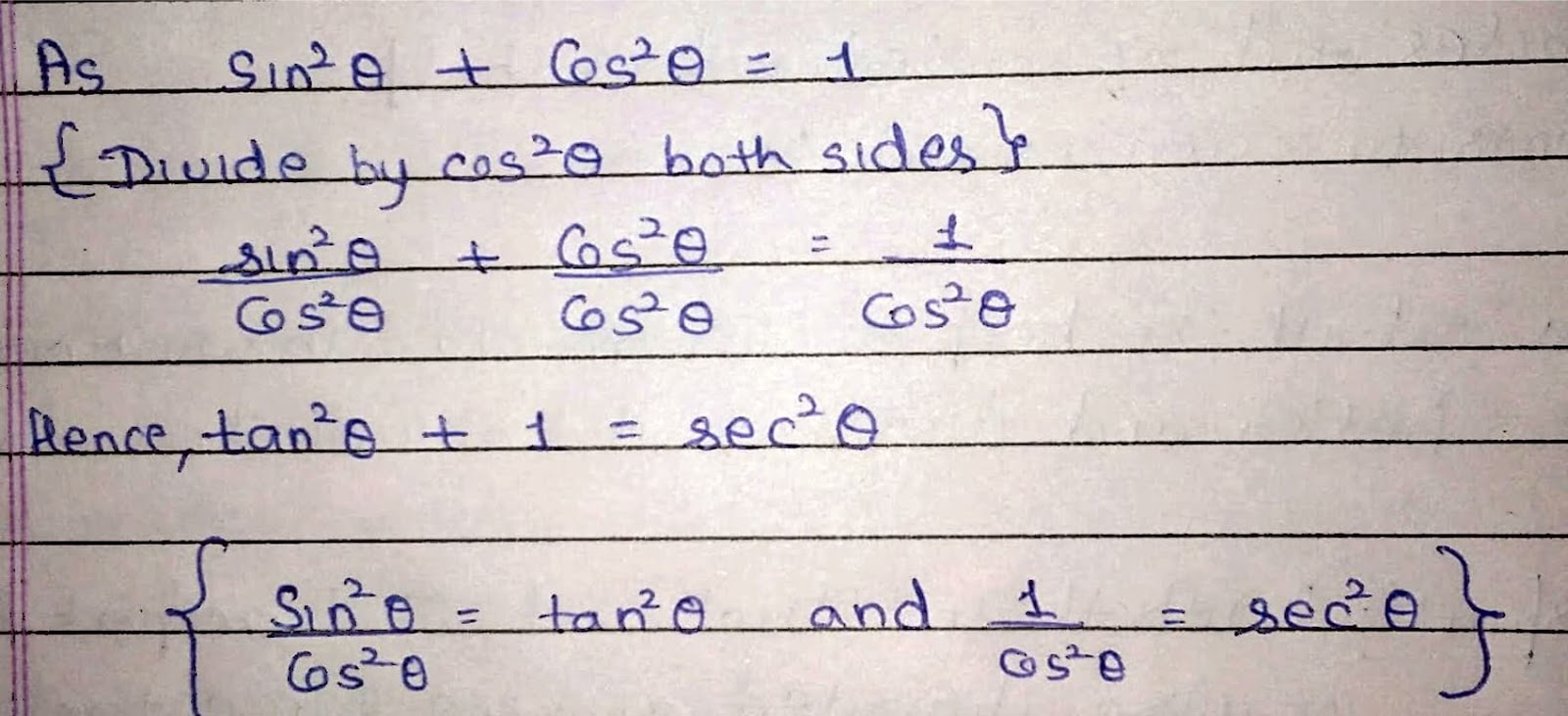
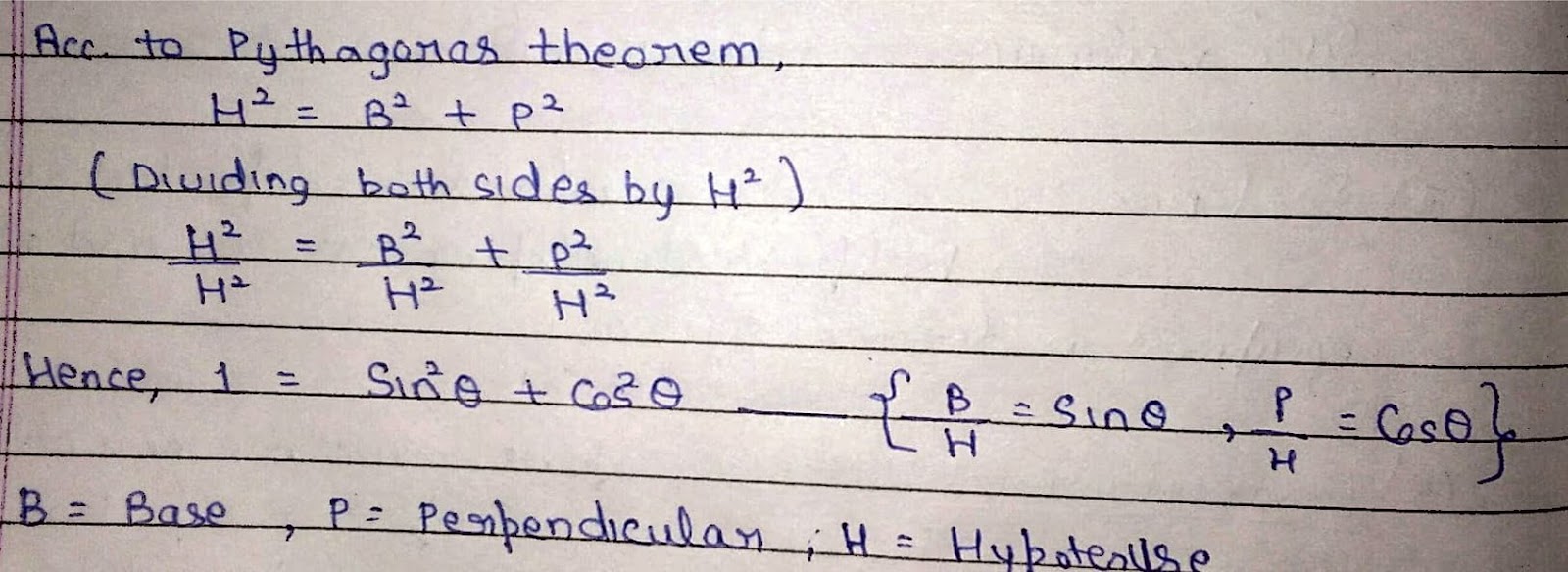
How Sin²θ + Cos²θ = 1...?? According to Pythagoras theorem, "the square of hypotenuse(H) is equal to the sum of square of base(B) and perpendicular(P)" i.e. H² = B² + P² (Dividing both sides by H²) we get, H²/H² = B²/H² + P²/H² 1 = Sin²θ + Cos²θ ....(B/H = sinθ and P/H = cosθ) Hence, Sin²θ + Cos²θ = 1 How Sin²θ + Cos²θ = 1?
What is Trigonometry? Trigonometry is a branch of mathematics that studies relationships between side lengths and angles of triangles. 👉👉 What is a Right angled triangle?
Comments
Post a Comment
Comment here